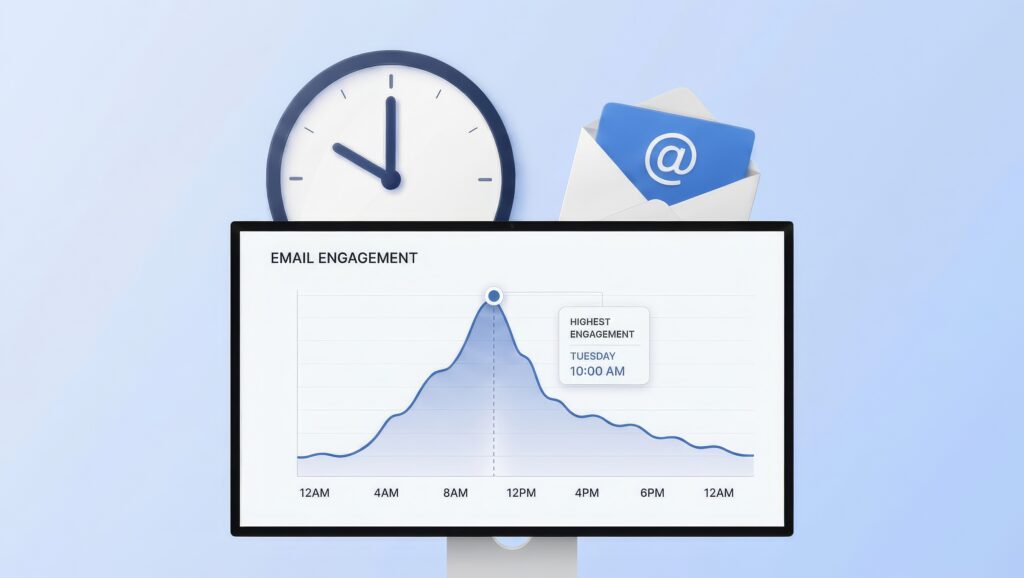

Tuesday at 10 a.m.
That seems to be the general answer every article gives you. It isn’t wrong. It’s just incomplete.
As a starting point, the popular answer is fine: mid-week, mid-morning, hit send, you’ll do okay.
But “okay” leaves money on the table. The slot that actually drives revenue is the one that matches when your customers buy.
So here’s both. The defaults worth starting from today, then how to make them yours.
Start here: the defaults that work
If you want a slot you can use right now, this is it:
| Your goal | Start sending |
|---|---|
| Opens | Tuesday to Thursday, 8 to 11 a.m. |
| Clicks | Weekday mornings, or 5 to 7 p.m. |
| Revenue | Mid-to-late week, tested against your own data |
That’s the consensus, and it holds up. Omnisend’s 26-billion-email analysis points to mid-week mornings. So does a meta-analysis of ten studies, and a survey of three dozen marketers. Two things the table doesn’t show:
- Avoid Saturday. It’s the weakest day in the largest first-party studies (Klaviyo, Omnisend). Sunday is weak too, just not always the floor.
- The weekday gaps are tiny. Barely a point separates the good days across the whole week, so don’t overthink which one you pick.
So here’s what to do: choose a Tuesday-to-Thursday, mid-morning slot and send something this week. This is your floor. The rest of the post is about beating it.
The catch: opens are not sales
The default above mostly optimizes for opens. If you sell things, opens are the wrong target.
Two reasons. First, opens are inflated. Apple’s Mail Privacy Protection auto-opens email before a human sees it. And more than half of all opens now happen on Apple Mail. So your “best time by open rate” is partly measuring machines. (Some of your most reliable openers are robots. They never buy a thing.)
Second, people open and buy at different moments. Omnisend’s 26-billion-email analysis found Tuesday wins for opens but Friday wins for conversions. Why? Someone in a weekend-shopping headspace is likelier to check out. Opens cluster mid-morning; clicks and purchases skew later, from late afternoon into the evening. (A 2.1-million-campaign MailerLite study even found clicks peaking around 8 to 9 p.m.)
So treat the default as your floor, then tune toward the moment your customers buy.
Find your real best time (it’s already in your data)
Here’s the part worth your ten minutes. You don’t have to guess. You don’t have to borrow a stranger’s average. The best time to reach your customers is already in your data.
One firm dug into its own sends. Thursday 8 to 9 a.m. pulled 25%+ open rates. Tuesday mornings — the supposed golden slot — came in under 5%. Their best day was the consensus’s worst. Yours might be too.
Here’s how to find your best time:
- Pull up your stores order history. Export your orders and look at the day of week and hour they cluster. That’s when your customers are in buying mode, no survey required. If orders spike Thursday evenings and Sunday mornings, that’s your signal, whatever a benchmark says. Send into the run-up to those peaks, not against them.
- Read your own email reports. Which past sends earned the most clicks and revenue, and what time did they go out? Your best-performing emails are experiments you already ran for free. Look for the pattern.
- Glance at your site traffic. When does your store get the most visitors? People who are already browsing are people who are easy to reach.
- Then A/B test to confirm. Same email, two send times, comparable halves of your list. Change only the time, measure clicks and revenue (not opens), and run it across a few campaigns so it’s a pattern, not a fluke.
Or just ask AI to find your best sending time
You don’t need to be a spreadsheet wizard for any of this. Export your orders as a CSV and hand the timestamps to an AI assistant like Claude or ChatGPT. Ask it to group your orders by day of week and by hour, show you where they cluster, and suggest send times that land just before those peaks.
A prompt that works:
“Here’s my order export. Group the orders by day of week and by hour of day, tell me where they cluster, and recommend two or three email send times that would reach customers just before they tend to buy.”
A couple of minutes later you have a send-time recommendation built on your actual customers, not an industry average. Do the same with an export of your past email performance. Ask which of your previous sends earned the most clicks and revenue, and when they went out.
One rule: strip the personal data before you upload. Delete names, emails, and addresses. The tool only needs timestamps and order values. Cleaner, faster, and your customers’ details stay where they belong.
The benchmark gets you to the right neighborhood. Your own data hands you the address.
It also depends on what you’re sending
A “best time” only makes sense once you know the job of the email:
- A promo or sale blast. Time it for the buying window: mid-week as a default, late-week to test. (Friday is quietly the revenue king in Omnisend’s data. Tuesday gets the credit. Friday gets the sales.)
- A product launch or drop. Catch peak attention, usually morning, and send a teaser the day before so the launch lands on a primed list.
- A newsletter. People read newsletters when they have time, so these skew later in the day, and weekends can work where promos flop.
- An automated flow (welcome, cart, post-purchase). These fire on the shopper’s action, not your clock. Don’t force them onto a “best time.”
Send-time levers for ecommerce
A store has levers a generic “Tuesday 10 a.m.” post never mentions:
- Payday cycles. Engagement and spending tend to rise around the 1st and the 15th, when paychecks land. Time a promo to ride it.
- Weekday buy, weekend deliver. Shoppers planning weekend projects or gifts often buy Tuesday to Thursday so it arrives in time. Part of why late-week revenue spikes.
- Shipping-cutoff urgency. “Order by Thursday for weekend delivery” turns a send time into a reason to buy now.
- Time zones for flash sales. A limited-time offer should hit a good local hour for every subscriber, not all at once at your local 9 a.m.