
Right now, someone is adding your product to their cart and leaving without paying.
Not because they don’t want it (well maybe that’s why) but it could also be from a million different reasons:
- the shipping cost surprised them
- they got hit with surprise fees
- checkout is complicated
- their phone rang
- their baby started crying
- they just figured they’d “come back later”
- their kids figured out how to unlock the office door from the outside and are now saying “dad I’m hungry” even though they just ate enough pancakes to feed a football team…just me?
The numbers are brutal. Seven out of ten carts get abandoned. 70.22% to be exact. That’s the average across 50 Baymard Institute studies.
Most stores just let it happen. “Cart’s gone, oh well, on to the next visitor.”
That’s money walking out the door! Those people were one click from buying. Most of them don’t need convincing, they just need a nudge. A short series of automated emails wins a real chunk of them back, on autopilot, while you’re watching Netflix at 11pm.
Do not delay setting up this automation.
What’s actually recoverable
Let’s be honest. You’re not winning back all 70%. You can only email carts where they gave you their email address. A huge chunk of abandoners are anonymous. They never typed in an email. You’ve got nothing to work with.
So the real target isn’t “70% of carts.” It’s the carts where you actually have an email to follow up with.
Want a bigger pool to recover from?
- Capture the email earlier by having the email field at the top of checkout, not the bottom
- Offer an incentive for their email before checkout happens. A popup offering 10% off or free shipping in exchange for an email gets you the address while they’re still browsing. Now if they add to cart and leave, you already have a way in.
One more distinction worth getting right, because stores constantly blur it:
- Cart abandonment: they added to cart, then left. High intent. They picked specific products. This is what your recovery flow is for.
- Browse abandonment: they looked at products but never added to cart. Lower intent, more window-shopping. That deserves its own gentler nudge (a browse abandonment email), not a “you left something in your cart” message for a cart that doesn’t exist.
Everything below is for genuine cart abandoners.
The recovery sequence that works
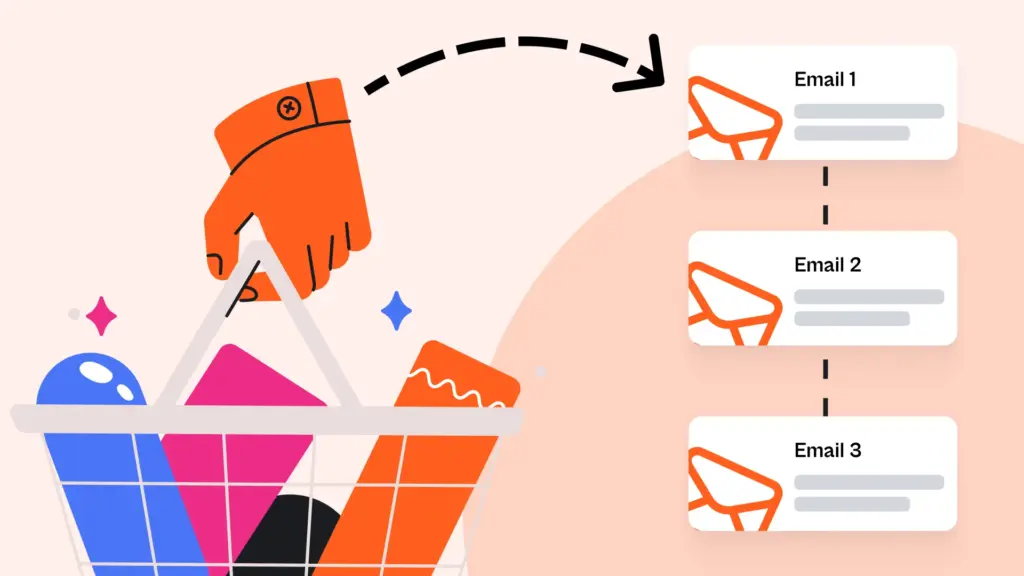
One email beats none. A short series beats one email, because each message catches people in a different headspace. Three, timed from the moment they bail:
- Email 1, the reminder (about 1 hour). Assume they got distracted. Show the exact items they left, with images, and one button straight back to the cart. No discount. Most people just need a reminder. Discounting someone who was going to pay full price anyway? That’s setting money on fire. (If you’re into that, go ahead. We won’t judge.)
- Email 2, the reassurance (about 24 hours). Handle the hesitation: free returns, shipping details, the guarantee. Most importantly, drop in a review of the thing they were eyeing. Still no discount. You’re making it easier to say yes, not bribing them.
- Email 3, the incentive (about 72 hours). If you’re going to use a discount, here’s where it earns its place. Add honest urgency (“your cart’s about to expire”) and make checkout one tap away with the discount code at the very top to get them back into the game.
Abandoned cart email subject lines that get opened
The whole sequence is worthless if nobody opens it.
Here are reusable formulas, each with a job:
- The reminder (email 1): “You left something behind.” / “Forgot something?”
- The Check In (open to find out): “Was it something we did?”
- Scarcity (later emails, only when true): “Your cart’s about to expire.”
- Personality (if it fits your brand): “Your cart called. It misses you.”
- The incentive (save for the final send): “Here’s 10% to finish what you started.”
Lead with the reminder lines and hold the discount lines for email three. And if you’re going to A/B test one thing in your recovery flow, make it the subject lines. They’re the cheapest lever you have: same email, same offer, same timing, but a better subject line could have massive effect.
Should you include a discount?
Should you? Not at first. And not always.
A discount feels like the obvious fix. It’s not. You train people to abandon.
Give shoppers a coupon every time they leave and congratulations, you’ve built a loyalty program where the reward is leaving.
The better play: don’t lead with a discount. Emails one and two should recover people through reminders and reassurance alone. Most of them just got distracted anyway.
Save the incentive for email three. By that point, everyone who just needed a nudge already bought. The discount only goes to genuine fence-sitters.
And when you do offer something, try free shipping before a percentage off. Baymard’s research found that 39% of shoppers abandon because of surprise costs at checkout: shipping, taxes, fees. That makes it the second biggest reason people bail. Shipping is usually the largest piece of that, and waiving it costs you less than a straight percentage discount.
Steal these: abandoned cart email templates
You don’t need to write these from scratch. Here are two free abandoned cart email templates to start from: the reminder and the closer.
Template 1: the reminder (send around 1 hour)
Subject: Leave something behind?
Preview: Your cart’s still here, ready when you are.
Hi [first name],
You left a few things in your cart. We saved them for you:
[Product image] [Product name] [Price]
[Return to cart]
Questions before you buy? Just reply to this email, a real person will answer.
[Brand]
Template 2: the reassurance (send around 24 hours)
Subject: Still thinking it over?
Preview: Free returns, fast shipping, no risk.
Hi [first name],
Your cart’s still saved. Here’s the deal:
- Free returns, always. If it’s not right, send it back.
- [Shipping + delivery details]
- [Your guarantee / warranty]
[Product image] [Product name] [Price]
“[Short customer review of this product]” — [Reviewer name]
[Return to cart]
[Brand]
Template 3: the closer (send around 72 hours)
Subject: Still not sure?
Preview: Here’s 10% off your cart.
Still on the fence? Totally fair.
We want to give you 10% off to give us a try. Code: SAVE10
[Product image] [Product name] [Price]
[Check out now]
Free returns, always. If it’s not right, send it back.
[Brand]
Abandoned cart email best practices
What separates a recovery email that works from one that gets deleted:
- Make the cart the hero. Real products, real images, front and center. Not a wall of brand copy vomit.
- One job per email. Reminder, then reassurance, then incentive. Never cram all three into one send.
- One button. A single CTA that drops them into a pre-filled cart, no re-adding required.
- Sound like the store they were just on. The email should match the brand, not read like a system alert.
- Mobile-first. It’s getting opened on a phone. Design for the thumb.
- Real urgency only. “Low stock” and “cart expiring” work when true and erode trust when fake.
How to measure it honestly
Watch one number first: conversion rate. How many people entered the flow and actually bought. Open rates? Ignore them. Privacy tools inflate them and they’ll lie to you. Clicks are a better signal and they tell you people are engaging. But clicks without conversions? Something’s broken at checkout. If you’re below 3% clicks, dig in.
PS — You don’t have to build any of this from scratch. Reachly gives you a pre-built abandoned cart flow. Drop in your branding, set your timing, and it fires the moment someone leaves a cart behind.